
The middle class, as the pillar of the economy, determines the moral compass in it. A shrinking middle class entails a larger inequality of wealth — a trend the numbers already confirm: in the US, the share of adults living in middle-income households fell from 61% in 1971 to roughly 51% today, while the middle class’s share of aggregate income fell even further, from 62% to 42% over the same period (1). Across cultures, from ancient Greece to ancient China, the golden rule of perfection has always been associated with the concept of balance — Aristotle’s golden mean and Confucius’s Doctrine of the Mean both point to the same idea from different civilisations. Triaging among different interests and keeping the balance in decision-making creates harmony. Yes, harmony is the key.
The only constant in our world is change. There is no single equilibrium that will last forever. This may be triggered by natural disasters, war, scientific discoveries, and technological and technical innovations. While natural disasters and wars are negative, destructive events, science and technology are driven by curiosity and creativity. The emergence of generative AI is one of these, and it is constantly unfolding its impact across the globe. At the same time, it is changing the equation of our society and posing challenges to harness its transformative and revolutionary power.
Combining the thoughts I articulated above, there are two things we must bear in mind.
- Change will happen. It is just a matter of time.
- To profit from changes, we must empower the middle class.
How is AI changing this equation concretely?
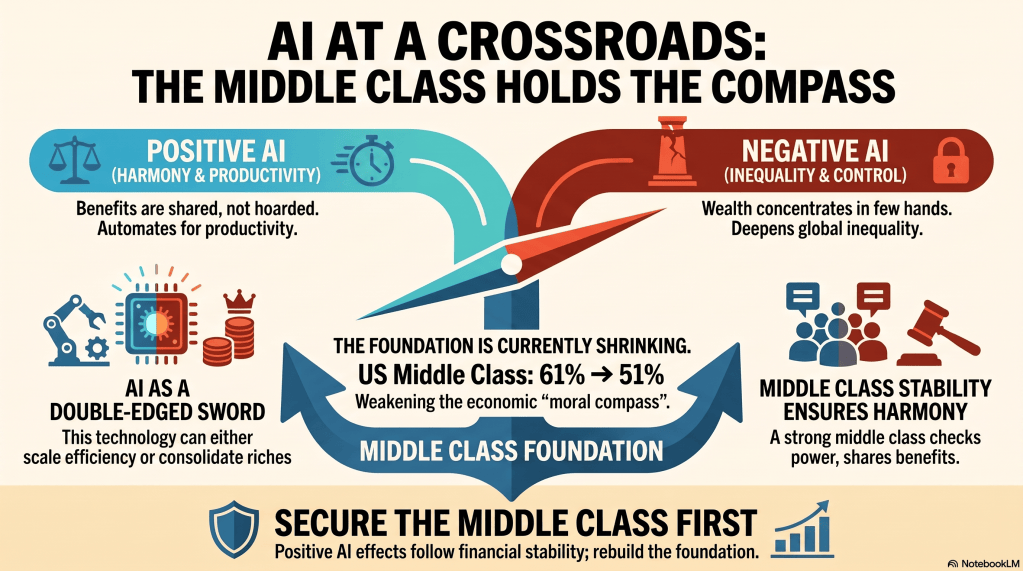
Each of these shifts can tilt toward broader benefit or toward deeper inequality — and the direction depends less on the technology itself than on whether the middle class is strong enough to absorb it when it arrives.
- The Labour Market: Automation in software with agents, and in the physical world with humanoid robots, is restructuring the labour market significantly (2).
- Information, Opinion and Education: Deepfakes, social media and AI-generated content will change the way people receive and process information (3).
- The Distribution of Wealth: the return on capital investment will increase further while labour income will decrease — a dynamic Thomas Piketty captured in his now-famous r > g formula (4).
- Scientific Innovation and Destruction: this covers our understanding of the universe, biology, chemistry and so on. The adoption of generative AI will undoubtedly speed up scientific discovery — AlphaFold’s Nobel Prize-winning breakthrough in protein structure prediction is an early proof point (5). This can cure people and extend life expectancy, but it can also be destructive if abused.
- Control and Crime: highly automated systems that evaluate massive amounts of information to prevent crime will be adopted more profoundly (6). At the same time, this increases the risk of totalitarian control.
- Environment: the massive amount of energy and water needed for data centres will further accelerate pollution and climate change (7). At the same time, a better understanding of the world through AI-based simulation, connected with new scientific innovation, can create a chance to reverse or counterbalance the harm.
The pattern repeats across every domain above: the same automation that could lift productivity for everyone can just as easily concentrate it in a few hands; the same information tools that could inform can just as easily manipulate; the same capital returns that could be shared can just as easily be hoarded. A strong middle class is what tips the balance towards the first outcome in each case, not the second.
The middle class tends to share a few things in common: they can provide for themselves, their family and the people around them, without needing to chase money, power or ownership as ends in themselves. They tend to look out for others in society and stay attentive to the environment and to social peace. In doing so, the middle class also acts as a healthy check on politics, quietly shaping the overall direction a society takes.
Focus on securing the financial stability of the middle class first — the positive effects of AI will follow from that foundation, not the other way round. AI will reshape labour, wealth, information and power regardless of what we wish for. Ask, then, not whether AI will transform the equation, but for whom: aim it towards rebuilding the middle class, not hollowing it out. Carry that focus into whatever comes next.
Sources
- Pew Research Center — How the American middle class has changed in the past five decades
- Goldman Sachs Research — Generative AI could raise global GDP by 7%
- World Economic Forum — Global Risks Report 2026
- TED Ideas — Thomas Piketty’s “Capital in the Twenty-First Century” explained
- The Nobel Prize — Press release: The Nobel Prize in Chemistry 2024
- Brennan Center for Justice — The Dangers of Unregulated AI in Policing
- IEA — Energy and AI: Executive Summary

 Crowd Minds
Leave a comment